AI Agent Tools and MCP: Designing Interfaces a Model Can Use Safely
August 29, 2026
Memory Architecture for AI Agents: Sessions Knowledge and Durable Lessons
September 1, 2026
NVIDIA DGX Spark is easiest to understand as a compact AI development appliance. It is not a conventional Windows workstation and it is not a substitute for the fastest discrete GPU when a model already fits in that GPU’s memory. Its appeal is the combination of 128 GB of coherent unified memory, NVIDIA’s software stack and unusually fast node-to-node networking in a 1.13-litre enclosure.
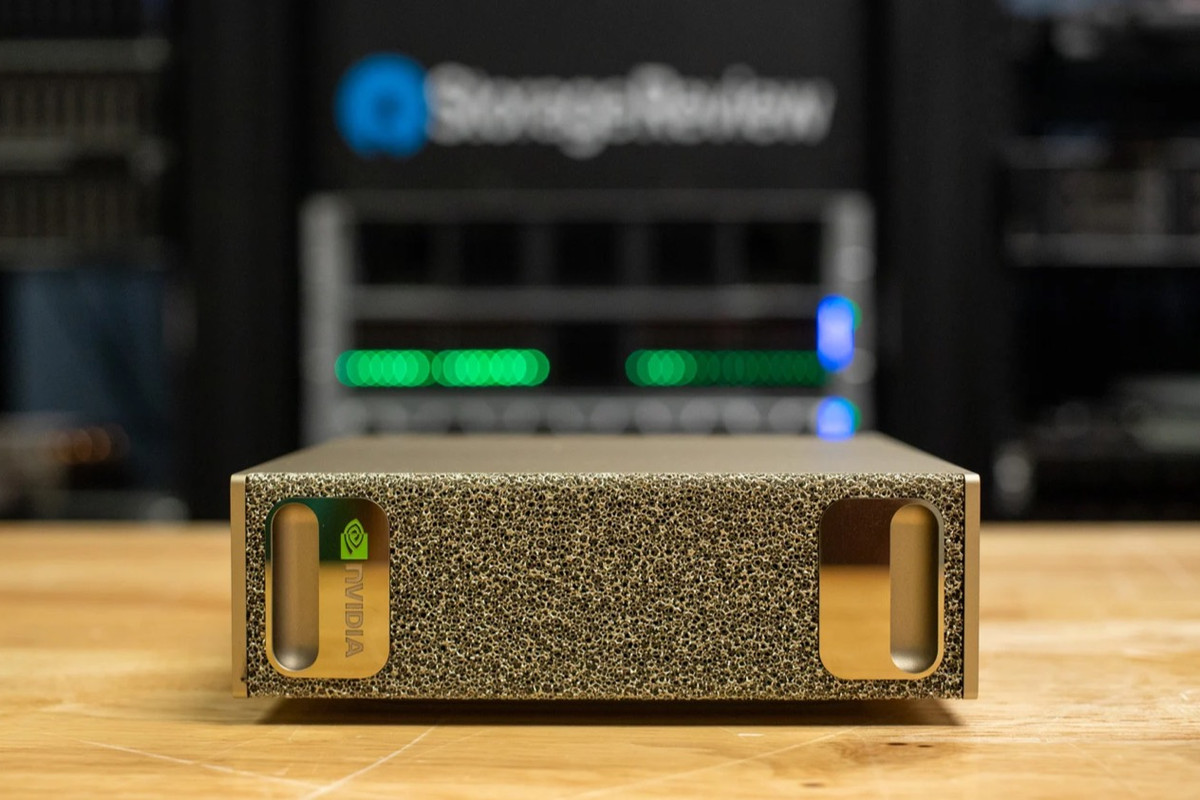
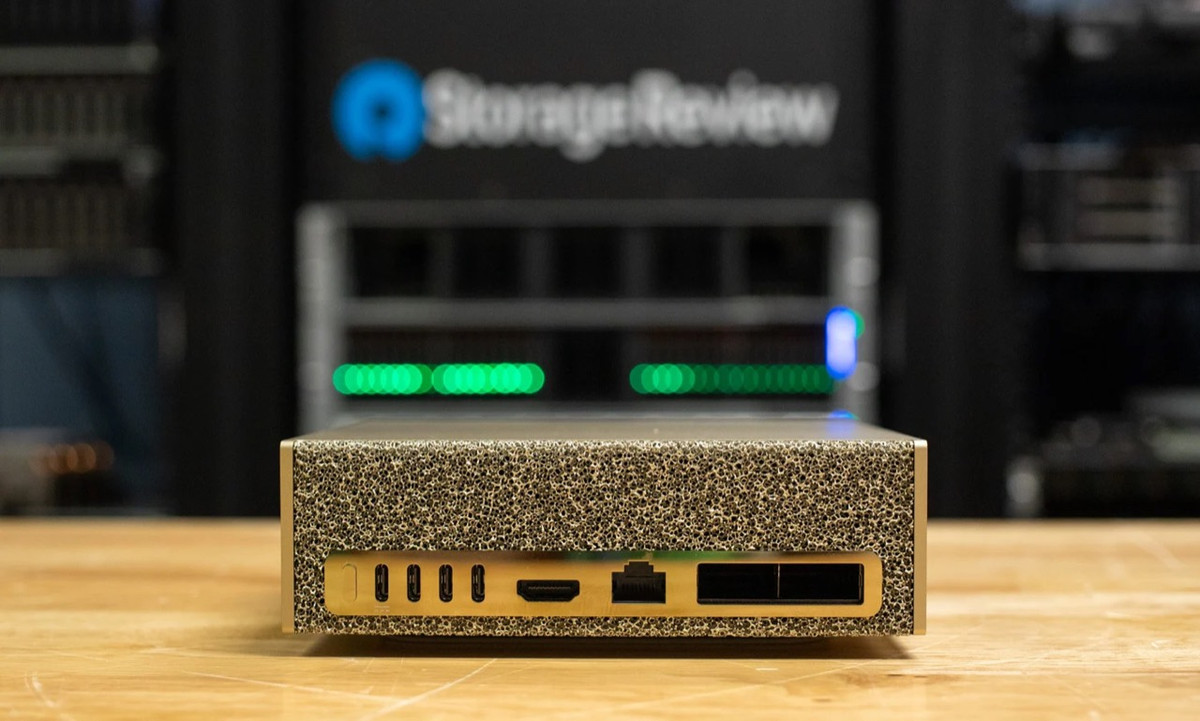
The 4 TB model uses the GB10 Grace Blackwell Superchip: a 20-core Arm CPU paired with a Blackwell GPU, fifth-generation Tensor Cores and up to 1 PFLOP of sparse FP4 tensor performance. NVIDIA specifies 273 GB/s of memory bandwidth, a self-encrypting 4 TB NVMe M.2 SSD, 10GbE, Wi-Fi 7 and a ConnectX-7 interface capable of a 200 Gb/s link. The company says one unit can perform inference with models up to 200 billion parameters and fine-tune models up to 70 billion parameters. Those are capacity claims, not guarantees of interactive speed: quantization, context length, KV cache, runtime and workload still determine whether a model fits and how quickly it responds.
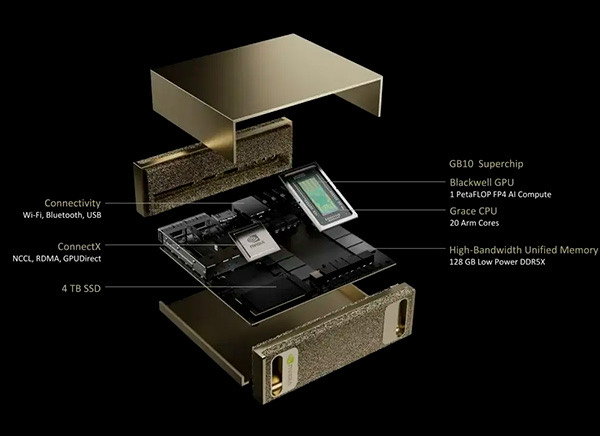
That distinction explains the product’s character. A high-end desktop GPU can offer much higher memory bandwidth and faster generation for models that fit its VRAM. DGX Spark trades that peak speed for a much larger addressable memory pool. It is useful when a developer needs to inspect, quantize or evaluate larger open models locally, keep sensitive inputs off a shared cloud service, or reproduce work in a CUDA-oriented environment before moving it to data-centre NVIDIA infrastructure.
Independent testing adds necessary limits to the headline specifications. StorageReview found the chassis compact, dense and well built, but also documented that the two physical QSFP interfaces do not provide 400 Gb/s aggregate throughput; the platform exposes a maximum 200 Gb/s path because of its topology. Tom’s Hardware highlighted 273 GB/s shared memory bandwidth as the principal constraint compared with discrete GPUs. Reviews nevertheless valued the quiet form factor, broad AI tooling and ability to connect two nodes for workloads that need more aggregate memory.
Owner feedback is more divided. Reports in LocalLLaMA and NVIDIA communities praise the ability to load large models and the preconfigured CUDA environment, while others describe early display, Arm package and framework-compatibility friction. These reports are anecdotal and often depend on the DGX OS release, container image and runtime flags, so they should guide a compatibility test rather than be treated as a universal verdict.
The economic case also changed. NVIDIA confirmed that the US MSRP rose from $3,999 to $4,699 in February 2026 because of memory-supply constraints, with no hardware change. At that price, DGX Spark makes sense for teams that value 128 GB, CUDA and 200 Gb/s clustering more than maximum tokens per second per dollar. It is harder to justify for ordinary productivity, gaming, small models or workloads already served efficiently by a 24–32 GB GPU.
Before buying, test the exact frameworks and containers you need on Arm64, estimate usable memory after the operating system and KV cache, and price cloud alternatives for the expected duty cycle. Compare the closely related HP ZGX Nano, Acer Veriton GN100 and Dell Pro Max with GB10, then use the five-device comparison for the purchase decision.