From AI Demo to Reliable Workflow
September 22, 2026
Local AI Hardware: When an NPU Helps — and When You Still Need a GPU or Cloud
September 23, 2026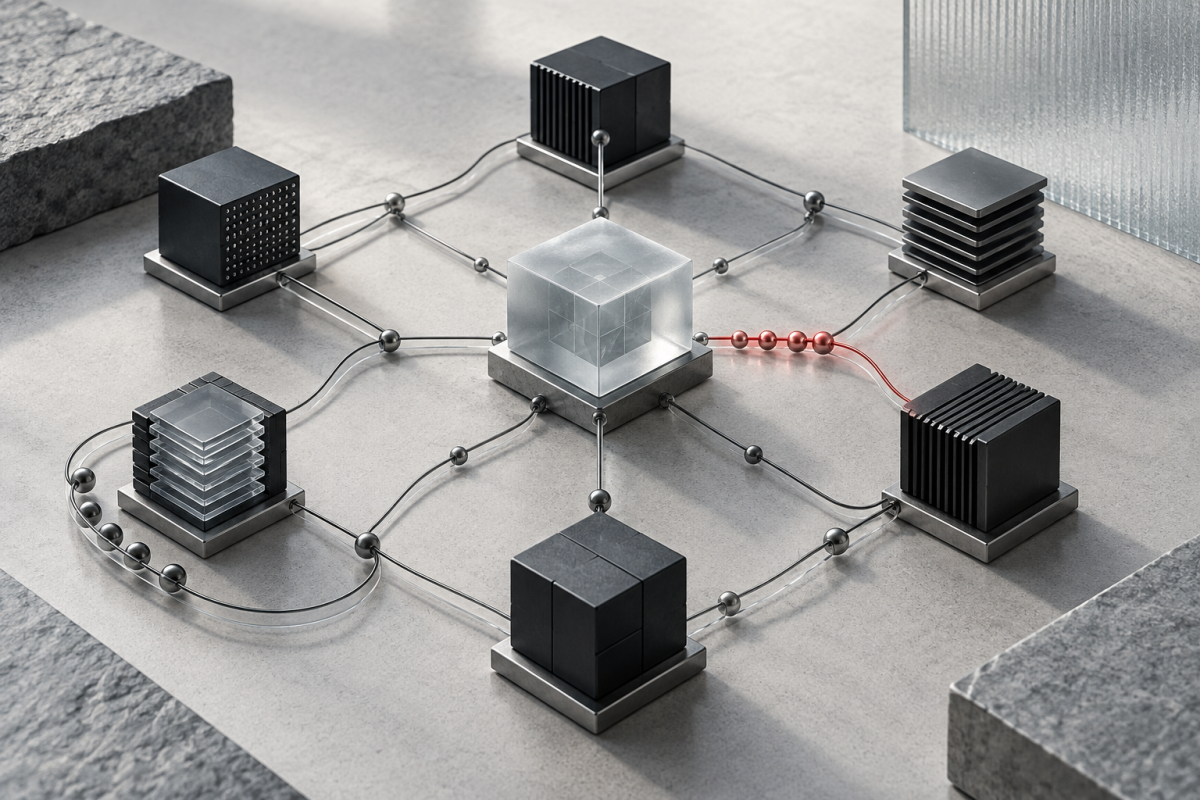
A multi-agent system is useful when separate agents contribute different information, tools or independent verification. It is wasteful when several models repeat the same analysis under different names.
Three collaboration patterns
Manager and specialists: A coordinator decomposes the task, assigns bounded work and synthesizes results. This is effective for parallel research and heterogeneous tools.
Peer review: One agent produces an artifact and another reviews the artifact against explicit criteria. Context isolation can reduce shared blind spots, provided the reviewer sees the evidence it needs.
Decentralized collaboration: Agents discover and negotiate work without one manager. This can support cross-organization systems but makes authority, conflict resolution and stopping harder.
Shared or isolated context
Shared context preserves detail and simplifies coordination, but grows quickly and can lock every agent into the same assumptions. Isolated context supports specialization and privacy boundaries, but handoffs must be explicit.
A good handoff states the objective, inputs, allowed sources, constraints, expected output and acceptance check. “Research this topic” is not enough when another agent cannot see the manager’s hidden reasoning.
Evidence from production research systems
Anthropic reports that its multi-agent research system benefits from parallel breadth-first search on high-value tasks, while consuming far more tokens than ordinary chat and performing poorly when work has many dependencies or requires shared context. Those figures describe Anthropic’s system and evaluation, not a universal law. They illustrate the trade: additional context and parallel search can improve coverage at substantial cost.
Common failure modes
- duplicated work caused by vague delegation;
- cascading errors when unverified output becomes another agent’s input;
- homogeneous conclusions from agents using the same model and sources;
- responsibility gaps where each agent assumes another validated the result;
- concurrency conflicts in shared files or state;
- runaway loops, retries and uncontrolled token use.
Controls
Set a maximum number of agents and rounds. Give each agent distinct ownership. Use one writer for shared mutable state or apply concurrency control. Validate artifacts independently. Preserve source citations across handoffs. Keep a human or service owner accountable for the final decision.
A2A can standardize communication between independent agent systems, but the protocol does not choose the right topology or trust policy. Use it only after defining those boundaries.
When one agent is better
Prefer one agent when the task is sequential, context must remain tightly shared, latency matters or the expected value does not justify the additional cost. A single agent with good tools often outperforms a poorly coordinated team.
Read Workflow vs Agent vs Multi-Agent, A2A 1.0 and Agent Observability.
Primary sources
Adaptation note: This article was informed by the collaboration framework in AI Agents in Depth: Design Principles and Engineering Practice by Bojie Li and contributors, Apache License 2.0. It was independently rewritten and expanded with current protocol and engineering sources.